Let's introduce the answer to this question with some figures:
- 433 million Africans live in extreme poverty, representing 361% of the global population.
- 100 million Africans face food insecurity, on a continent that also holds 601,300,000 of the world's unexploited arable land.
- 400 million sub-Saharan Africans do not have access to drinking water
From a positive perspective, this data rightly demonstrates that Africa is a natural and fertile ground for applying the solution-oriented aspirations of artificial intelligence: those ideas that promise the technological resolution of all of society's ills, from poverty to better water management and the optimization of agricultural yields. It is precisely for this reason that the African continent is increasingly a coveted market, within which numerous AI initiatives and solutions are emerging in response to issues related to water, agriculture, and more. According to the research firm PwC, Africa (along with Oceania and certain underdeveloped Asian economies) could concentrate $1.2 trillion of the revenue generated by the artificial intelligence market by 2030, representing 5.1 trillion of the global contribution ($15.7 trillion).
This potential, which remains modest compared to the share of China and the United States of America (these two countries will concentrate 70% of the global contribution), is a boon for African youth, provided that they position themselves as actors, both producers and consumers, of this new digital economy, in accordance with their socio-economic and cultural needs.
It is important to remember that 311 million of the 420 million young Africans (aged between 15 and 25) are unemployed, and 351 million are employed in the vulnerable informal sector. Given this reality, we are convinced, following Lindiwe Matlali, that the solution to this youth unemployment problem lies in entrepreneurship and innovation. Hence the importance, the culmination of our argument, of introducing African youth to AI entrepreneurship: this type of entrepreneurship will combine artificial intelligence with addressing Africa's socio-economic challenges.
This is the whole point of our training program which started on January 12, 2022, in collaboration with Impact IA Foundation and Lycée Joss.
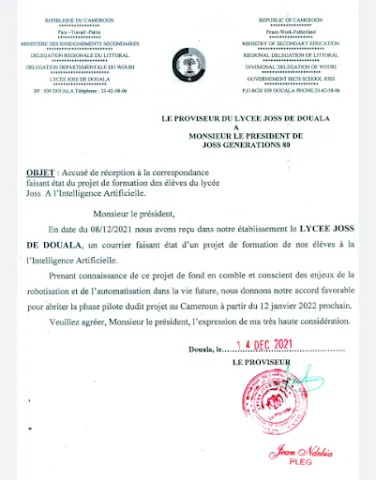
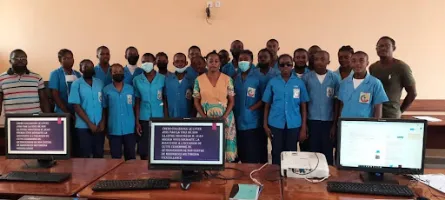
For this pilot project, 21 young people (11 girls and 10 boys) received training in the challenges of artificial intelligence, including the fundamentals of its development, its entrepreneurial applications, and its impact on the workplace. This certificate-awarding program will strengthen a partnership intended to gradually expand throughout Cameroon (in collaboration with the Ministry of Secondary Education) and across Africa. The primary objective remains the integration of entrepreneurship and artificial intelligence into secondary education programs in Africa.